Blog
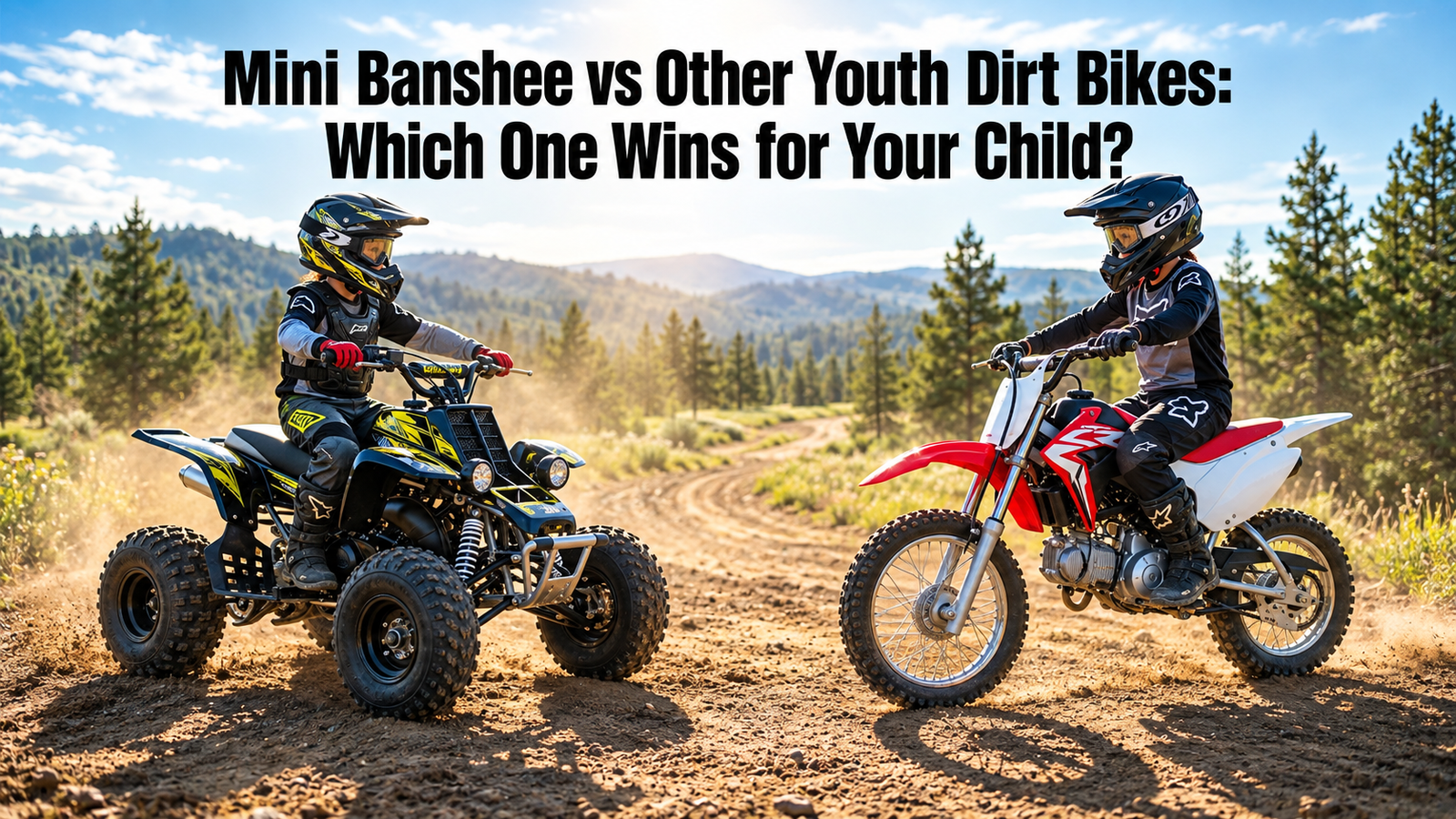
Mini Banshee vs Other Youth Dirt Bikes: Which One Wins for Your Child?

By FE-Motorsport | Kids Powersports | Buyer Guides and Comparisons
Shopping for your child’s first dirt bike is one of the most exciting purchases a family can make in the powersports world. It is also one of the most confusing. Walk into any conversation about youth bikes and you will immediately encounter a handful of names that keep coming up: the Mini Banshee, the Honda CRF50, the Yamaha PW50, the KTM 50 SX, the Kawasaki KX65. Each machine has its passionate advocates, its own character, and its own place in the youth riding development ladder.
So which one is actually right for your child?
At FE-Motorsport we have been helping families answer this exact question since 2016. We carry the Mini Banshee and have seen firsthand how it compares to the other machines families consider. This guide gives you an honest, detailed comparison across every factor that matters: price, performance, safety, ease of use, maintenance, and long-term value as a skill development tool.
By the time you finish reading, you will know exactly where the Mini Banshee stands in the youth dirt bike landscape and whether it is the right machine for your family.
The Contenders: Meet the Field
Before we dive into the comparison, here is a quick introduction to each machine in this lineup.
FE-Motorsport 49cc Gas Powered Mini Banshee
The Mini Banshee is a 49cc single-cylinder air-cooled 2-stroke mini bike inspired by the legendary Yamaha Banshee 350. It features an automatic centrifugal clutch, pull-start recoil, chain drive, and a steel tubular frame. Designed for riders aged 4 to 10, it is one of the most affordable genuine gas-powered entry points in the youth market. Available at FE-Motorsport for $500.
👉 Shop the 49cc Mini Banshee at FE-Motorsport
Honda CRF50F
One of the most respected names in youth dirt biking. The CRF50F is a 49cc 4-stroke air-cooled machine with a semi-automatic 3-speed transmission, reliable Honda engineering, and a reputation for being virtually indestructible. Retail price typically runs from $1,099 to $1,299 new.
Yamaha PW50
The Yamaha PW50 is arguably the most iconic beginner youth dirt bike ever produced. A 49cc 2-stroke with a fully automatic transmission and a built-in oil injection system that eliminates the need for manual fuel mixing. It has been introducing children to dirt biking for decades. New retail price is approximately $1,099 to $1,199.
KTM 50 SX
The performance choice at the 50cc level. The KTM 50 SX is a purpose-built competition machine with a powerful 49cc 2-stroke engine, a proper motocross chassis, and aggressive power delivery that mirrors what serious youth racers need. New retail price starts at approximately $4,299 and goes up with factory variants.
Kawasaki KX65
Sitting above the 50cc class, the KX65 is a 65cc 2-stroke competition machine for young riders ready to step beyond the beginner tier. It is included here as a reference point for where the progression from beginner machines leads. New retail price is approximately $3,699.
Head-to-Head Comparison Table
| Mini Banshee | Honda CRF50F | Yamaha PW50 | KTM 50 SX | Kawasaki KX65 | |
|---|---|---|---|---|---|
| Price (new) | $500 | $1,099 | $1,099 | $4,299+ | $3,699 |
| Engine | 49cc 2-stroke | 49cc 4-stroke | 49cc 2-stroke | 49cc 2-stroke | 65cc 2-stroke |
| Transmission | Auto centrifugal | Semi-auto 3-speed | Fully automatic | Manual 6-speed | Manual 6-speed |
| Fuel mixing | Yes (50:1) | No | No (oil injection) | Yes | Yes |
| Top speed | 15-20 mph | 20-25 mph | 15-20 mph | 30-40 mph | 40-50 mph |
| Best age range | 4 to 10 | 4 to 9 | 3 to 7 | 5 to 10 (racers) | 7 to 12 |
| Maintenance level | Low | Low to medium | Low | High | High |
| Competition ready | No | No | No | Yes | Yes |
| Skill progression | Good | Good | Good | Excellent | Excellent |
| Beginner friendly | Excellent | Excellent | Excellent | Moderate | Low |
Price Comparison: Where Your Money Goes
Let us start with the number that matters most to most families: the price.
The Mini Banshee at $500 is in a category of its own when it comes to value. The Honda CRF50F and Yamaha PW50 both sit at approximately twice the price at around $1,099 to $1,299. The KTM 50 SX starts at over four times the cost at $4,299 new, and the Kawasaki KX65 comes in at approximately $3,699.
For a first machine where you are testing whether your child will genuinely take to riding before committing to a larger investment, this price difference is enormously significant.
Consider what happens in the two most common scenarios:
Scenario A: Your child loves riding. You started with the $500 Mini Banshee, confirmed their genuine passion, and now you are ready to invest in a premium machine. You have saved $599 to $3,799 compared to starting on the more expensive options, and you can put that money toward a better machine at the next stage.
Scenario B: Your child loses interest after a few months. This happens more often than anyone likes to admit. Starting on the Mini Banshee means your financial exposure is $500 rather than $1,099 or $4,299. The Mini Banshee holds reasonable resale value, making the net cost of the experiment even lower.
In either scenario, the Mini Banshee’s price advantage is real and meaningful.
👉 View the 49cc Mini Banshee at FE-Motorsport
Engine and Performance: 2-Stroke vs 4-Stroke, Auto vs Manual
This is where the machines diverge most significantly, and where choosing the right option requires understanding what your child actually needs at their current stage.
The Mini Banshee vs Honda CRF50F: Auto vs Semi-Auto
The Mini Banshee uses a fully automatic centrifugal clutch. There is no manual gear selection and no clutch lever. Twist the throttle and the bike moves. Release it and the bike slows. For a complete beginner, this simplicity is a genuine advantage because it removes an entire layer of complexity from the learning process and lets the child focus entirely on balance, steering, and throttle control.
The Honda CRF50F uses a semi-automatic 3-speed transmission with no clutch lever but with a foot-operated gear shifter. This introduces the concept of gear selection without the complication of a manual clutch. It is a middle ground between fully automatic and fully manual, making it a solid choice for children who are ready to learn gear shifting but are not yet ready for a full manual clutch.
In terms of raw performance, the CRF50F’s 4-stroke engine produces smoother, more predictable power than the Mini Banshee’s 2-stroke. The 4-stroke power delivery is more linear and forgiving for beginners. The Mini Banshee’s 2-stroke produces more immediate throttle response, which some children find exciting and others find slightly more demanding to manage initially.
The Mini Banshee vs Yamaha PW50: Automatic vs Automatic
This is perhaps the most direct comparison on this list, as both machines are fully automatic and aimed squarely at the youngest, least experienced riders.
The Yamaha PW50 has a significant advantage in that its oil injection system eliminates the need for manual fuel mixing. You fill the tank with regular pump gas and the system meters the 2-stroke oil automatically. For parents who do not want to deal with premix ratios, this is a meaningful convenience. It does come at a cost premium of approximately $599 over the Mini Banshee.
Performance wise, both machines are closely matched in terms of top speed and power output. The PW50 has an exceptionally wide powerband for a 2-stroke that makes it very forgiving, which is by design. The Mini Banshee’s powerband is similarly manageable at the beginner level.
Where the Mini Banshee has an advantage is in its styling and character. The Banshee-inspired design and the authentic 2-stroke experience resonate strongly with both young riders and their parents who grew up in the powersports world. The PW50 is a brilliant machine, but the Mini Banshee delivers a more exciting ownership experience at less than half the price.
The Mini Banshee vs KTM 50 SX: Beginner vs Racer
This comparison is less of a head-to-head and more of a developmental stage discussion. The KTM 50 SX is not a beginner machine. It is a purpose-built competition dirt bike with a manual 6-speed transmission, aggressive power delivery, and race-focused ergonomics. Putting a first-time rider on a KTM 50 SX is like teaching someone to drive in a racing car.
The KTM 50 SX belongs in the hands of young riders who have already learned the fundamentals on a beginner machine like the Mini Banshee, who have a clear competitive ambition, and whose families are ready to invest in the ongoing maintenance demands of a competition machine.
For everyone else, the $3,799 price difference between the Mini Banshee and the KTM 50 SX is one of the most straightforward value comparisons in the youth powersports market.
Safety and Beginner Friendliness
All five machines in this comparison are appropriate for young riders when used with proper supervision and protective gear. But they are not equally friendly for complete beginners, and that distinction matters enormously when you are putting a child on a motorized vehicle for the first time.
The Mini Banshee and the Yamaha PW50 are the most beginner-friendly machines in this lineup. Their fully automatic transmissions eliminate the cognitive load of gear management, their power outputs are modest and manageable, and their top speeds keep the consequences of beginner errors relatively minor.
The Honda CRF50F is very close behind, with its semi-automatic transmission adding one gentle layer of complexity that most children manage within a few sessions.
The KTM 50 SX and Kawasaki KX65 are at the other end of the spectrum. Their manual transmissions, more aggressive power delivery, and competition-oriented handling characteristics demand a level of skill and attention that beginners simply do not have yet. These are machines for developed young riders, not first-timers.
For safety-conscious parents who are introducing their child to gas-powered riding for the first time, the Mini Banshee’s automatic clutch and controlled power delivery make it one of the most responsible choices available at any price.
👉 Shop Kids Mini Bikes and ATVs at FE-Motorsport
Maintenance: What Each Machine Actually Demands
Maintenance is one of the most underappreciated factors in choosing a youth bike, particularly for parents who are new to powersports and do not have a mechanical background.
Mini Banshee: Low maintenance. The main tasks are mixing fuel at the correct 50:1 ratio, cleaning the air filter every few rides, checking chain tension before sessions, and replacing the spark plug each season. No oil changes, no complex service procedures.
Honda CRF50F: Low to medium maintenance. The 4-stroke engine requires periodic oil changes (every 5 to 10 hours of riding), air filter cleaning, and valve clearance checks every 20 to 40 hours. More involved than the Mini Banshee but manageable for a motivated parent.
Yamaha PW50: Low maintenance. The oil injection system eliminates fuel mixing, making it arguably the simplest machine on this list to operate. Standard 2-stroke maintenance otherwise applies.
KTM 50 SX: High maintenance. As a competition machine, the KTM 50 SX demands frequent piston and ring replacement (every 10 to 15 hours of hard riding), regular transmission oil changes, and more frequent overall servicing than any beginner machine. The ongoing cost of consumables and service is significant.
Kawasaki KX65: High maintenance. Similar to the KTM, this is a competition machine that demands competition-level maintenance schedules and budgets.
For families new to powersports who want to minimize the mechanical demands on their time and budget while their child learns to ride, the Mini Banshee and the Yamaha PW50 are the clear winners in this category.
Skill Development: Which Machine Teaches Better Riding?
Every machine on this list will teach a young rider to ride. But they teach different things, at different rates, and prepare riders for different futures in the sport.
The Mini Banshee and Yamaha PW50 teach the absolute fundamentals: throttle control, balance, steering, and braking. These are the skills every rider needs before anything else. Their automatic transmissions mean the fundamentals are learned without the distraction of gear management.
The Honda CRF50F adds one developmental step with its semi-automatic gear shifting, making it a useful bridge between fully automatic and fully manual machines. A child who graduates from a Mini Banshee to a CRF50F is on a very natural progression path.
The KTM 50 SX and Kawasaki KX65 teach all of the above plus manual clutch operation, gear selection strategy, and competition-level riding technique. They are the best skill development tools on this list for riders who are heading toward organized motocross, but they are only effective in that role once the rider already has the fundamentals from an earlier machine.
The takeaway is that skill development is a ladder, not a single step. The Mini Banshee is the bottom rung of that ladder, and it is the most important rung because it is where the foundation is built. Every great young rider starts somewhere foundational. Most of them start on machines very much like the Mini Banshee.
The Ideal Progression Path
Based on everything above, here is the progression path we recommend at FE-Motorsport for most young riders:
Stage 1 (Ages 4 to 8): Mini Banshee at $500. Learn the fundamentals. Build confidence. Confirm genuine interest in riding.
Stage 2 (Ages 7 to 10): Honda CRF50F or Yamaha PW50 or similar. Introduce gear shifting. Build technique. Begin riding on actual trails or beginner tracks.
Stage 3 (Ages 9 to 12): 110cc to 125cc dirt bike or KTM 50 SX for competition-oriented riders. Develop full manual clutch operation. Begin organized racing if desired.
Stage 4 (Ages 12 and up): 125cc 2-stroke or 250cc 4-stroke. Full-size youth machine. Competition-ready performance.
At FE-Motorsport, we carry machines across multiple stages of this progression. Whatever your child is ready for today, we have the right machine for them.
👉 Shop All Kids ATVs and Mini Bikes at FE-Motorsport 👉 Shop Dirt Bikes at FE-Motorsport 👉 Shop Parts and Accessories at FE-Motorsport
Which One Should You Buy?
Here is the honest summary for each machine and who it is best suited for:
Buy the Mini Banshee if: Your child is a complete beginner aged 4 to 10, budget is a priority, you want the lowest-risk entry into gas-powered riding, or you want an authentic 2-stroke experience at an unbeatable price. Available at FE-Motorsport for $500.
Buy the Honda CRF50F if: Your child is ready for their first introduction to gear shifting, you want Honda reliability and dealer support, and your budget allows $1,099 to $1,299.
Buy the Yamaha PW50 if: Your child is on the younger end (3 to 7 years old), you want zero-fuss operation with no fuel mixing required, and you are willing to pay a premium for that convenience.
Buy the KTM 50 SX if: Your child has already mastered the fundamentals on a beginner machine and has a clear competitive ambition toward organized motocross racing. Budget and maintenance demands are not a constraint.
Buy the Kawasaki KX65 if: Your child has outgrown the 50cc competition class and is ready for the next step up in youth racing performance.
For the vast majority of families reading this guide, the Mini Banshee at $500 is the right answer. It delivers everything a beginner needs, nothing they do not, and does it at a price that makes the first step into powersports genuinely accessible for any family.
👉 Buy the 49cc Mini Banshee Now at FE-Motorsport
Frequently Asked Questions
Q: Is the Mini Banshee better than the Yamaha PW50 for a first-time rider? Both are excellent first machines and are very closely matched in terms of power, automatic transmission, and beginner friendliness. The key differences are price and fuel management. The Mini Banshee is approximately $599 less expensive and requires manual fuel mixing at a 50:1 ratio. The PW50 costs more but uses an oil injection system that eliminates mixing. For most families, the Mini Banshee’s $500 price point makes it the more accessible and lower-risk starting point, while the PW50 is a great choice for families who want to eliminate all fuel management complexity.
Q: Can a 4-year-old ride the Mini Banshee? Yes, depending on the child’s size and maturity. The Mini Banshee’s low seat height, fully automatic transmission, and manageable power make it accessible for many 4-year-olds. The key requirement is that the child can reach the ground comfortably with at least one foot and can follow basic instructions reliably. Always supervise young riders closely and start on flat, open ground.
Q: How does the Mini Banshee compare to the Honda CRF50F in terms of power? The Mini Banshee’s 2-stroke engine produces slightly more immediate throttle response due to the nature of 2-stroke power delivery, while the CRF50F’s 4-stroke engine produces smoother, more linear power that is arguably more forgiving for beginners. In terms of top speed, both machines are closely matched at 15 to 25 mph. The CRF50F’s semi-automatic gearbox gives it a slight edge in rider development over time, but the Mini Banshee’s simpler operation and lower price make it the smarter first step for most families.
Q: Is the KTM 50 SX too powerful for a beginner? Yes, for the vast majority of beginners the KTM 50 SX is too powerful and too demanding. Its manual 6-speed transmission, aggressive power delivery, and competition-focused setup require a level of skill and attention that first-time riders do not have. The KTM 50 SX is best suited for young riders who have already developed solid fundamentals on a beginner machine and have clear competitive ambitions. Start on the Mini Banshee and work up to the KTM when the time is right.
Q: What protective gear does my child need for any of these bikes? Regardless of which machine you choose, every young rider needs a DOT-approved full-face motocross helmet, gloves, knee and shin guards, elbow pads, and sturdy closed-toe boots before every single ride. No exceptions. These items are available from a range of suppliers and a complete beginner gear set can be assembled for $200 to $300, which is a worthwhile investment alongside any machine on this list.
Q: Which bike on this list is the easiest to maintain for a parent with no mechanical experience? The Mini Banshee and the Yamaha PW50 are the easiest to maintain. The Mini Banshee requires correct fuel mixing, air filter cleaning, chain maintenance, and an annual spark plug replacement. The PW50 eliminates fuel mixing but otherwise has similar requirements. Both are well within reach for a parent with no prior mechanical background and a basic toolkit.
Q: Does the Mini Banshee hold its resale value? The Mini Banshee holds reasonable resale value, particularly when it has been well maintained and kept in good cosmetic condition. Given its $500 purchase price, even a modest resale return represents a low net cost for the ownership experience. Premium machines like the Honda CRF50F and KTM 50 SX also hold strong resale value due to brand recognition and aftermarket demand.
Q: What is the next bike after the Mini Banshee when my child is ready to upgrade? The natural next step from the Mini Banshee is a semi-automatic or fully manual 50cc to 110cc youth dirt bike such as the Honda CRF50F, Honda CRF110F, or Yamaha TT-R110LE. For riders showing early competitive ambition, moving directly to a KTM 50 SX after mastering the Mini Banshee fundamentals is a well-trodden path. FE-Motorsport carries machines across the full youth progression ladder.
Q: Are there other kids ATVs or mini bikes to consider alongside these dirt bikes? Absolutely. Kids ATVs are a great alternative for younger or more cautious riders who benefit from four-wheel stability. FE-Motorsport carries a range of kids ATVs alongside the Mini Banshee and other mini bikes. If your child is very young or nervous about two-wheeled riding, a 49cc ATV can be a great confidence-building starting point before transitioning to a bike.
👉 Browse Kids ATVs at FE-Motorsport
Q: Where can I buy the Mini Banshee in the USA? The 49cc Gas Powered Mini Banshee is available in stock right now at FE-Motorsport, a 100% American-owned and operated powersports dealer serving families across the USA since 2016. You can shop online at femotorsport.com or contact our team directly for help choosing the right machine for your child.
Q: How do I know which bike is right for my specific child? The best starting point is a conversation with our team at FE-Motorsport. Tell us your child’s age, size, riding experience, and goals, and we will help you match the right machine to where they are right now and where they want to be. We have helped thousands of families make this decision and we are happy to help yours too.
The Bottom Line
Every machine on this list has earned its place in the youth dirt bike conversation. The Honda CRF50F is a legend. The Yamaha PW50 has introduced more children to riding than perhaps any other machine ever made. The KTM 50 SX is a championship-winning competition tool.
But for the family looking for the best combination of value, accessibility, beginner friendliness, and authentic gas-powered riding experience, the 49cc Gas Powered Mini Banshee from FE-Motorsport is the most compelling starting point in this entire lineup.
At $500 it gives your child everything they need to fall in love with riding without requiring you to spend twice or eight times as much to find out whether that love is real.
That is a hard case to argue against.
👉 Shop the 49cc Mini Banshee at FE-Motorsport 👉 Browse All Kids ATVs and Mini Bikes 👉 Shop Dirt Bikes for Every Stage 👉 View Our Full Powersports Inventory
📞 (909) 342 5340 | 📧 support@femotorsport.com
American-owned and operated since 2016. Real riders. Real knowledge. Real support.